


Industrial vs. Commercial HVAC Requirements: Key Differences Explained

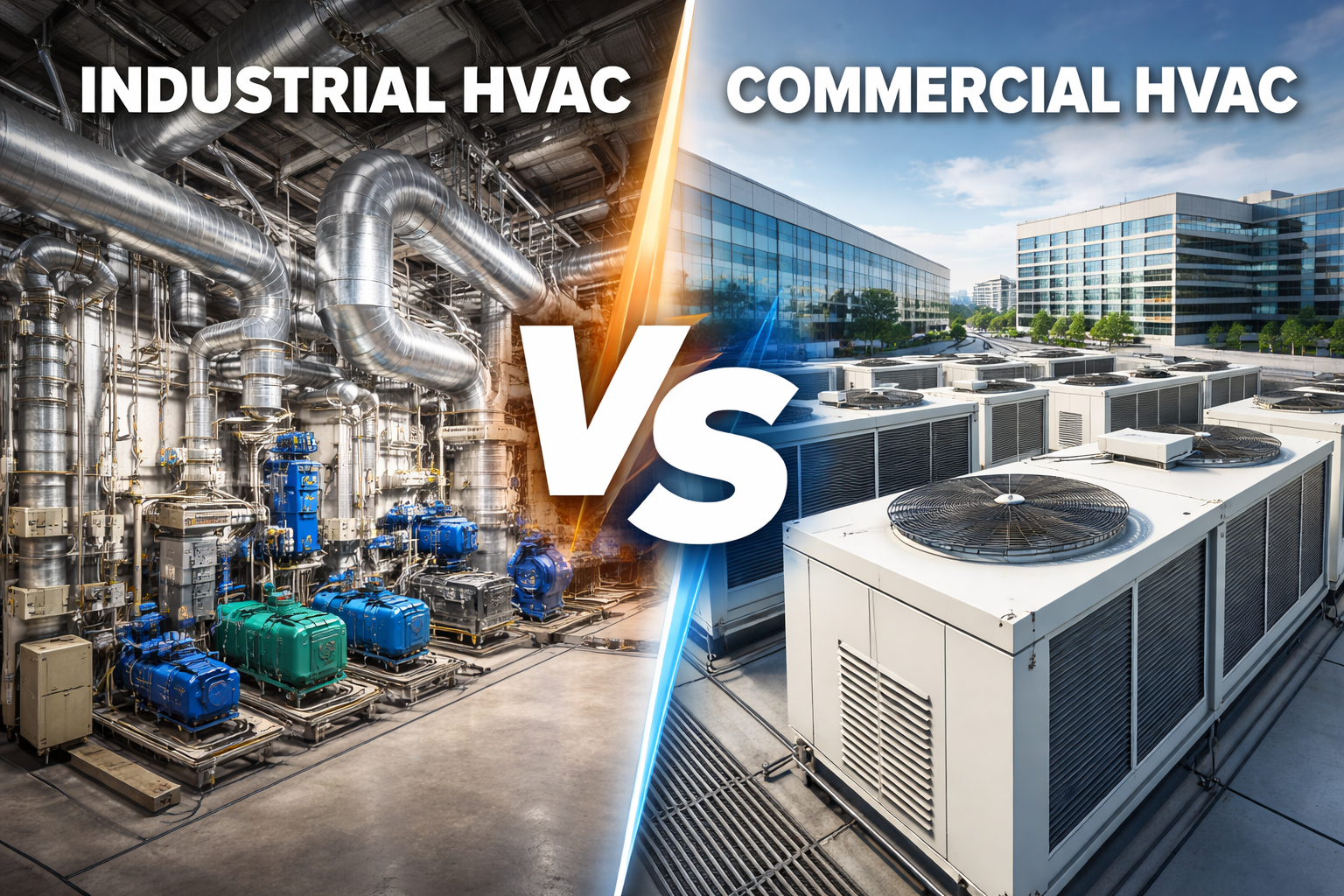
Choosing between industrial HVAC systems and commercial HVAC systems is a very crucial decision affecting safety, efficiency, compliance, and consequently long-term operational costs. HVAC requirements are very often treated alike across facilities, but the reality is very different once application, load, and risk factors are taken into account.
This blog provides lucid and practical clarity on the real differences in industrial vs commercial HVAC requirements to assist decision-makers in selecting systems that support performance, reliability, and regulatory needs, and help avoid unnecessary upgrades or rework later.
Purpose-Driven HVAC Design: Comfort vs Control
The most basic differentiation between industrial and commercial would be in the purpose of the systems themselves.
Commercial applications in HVAC will be biased towards thermal comfort and indoor air quality intended for the occupants. Places of work, malls, hospitals, hotels, and institutions of learning need a constant temperature, controlled humidity, and quiet operations.
Industrial HVAC systems exist to control the environments that directly influence processes, machinery, and safety. In manufacturing units, tunnels, power plants, data centers, and other industrial buildings, HVAC would be required to dissipate heat, remove pollutants, balance pressure, and provide fire safety.
That makes for a purpose-driven difference in every subsequent technical decision.
Load Handling and Operational Intensity
Commercial HVAC Load Characteristics
Commercial buildings experience:
- Predictable occupancy patterns
- Limited operating hours
- Moderate internal heat generation
As a result, systems prioritize energy efficiency, zoning flexibility, and user comfort.
Industrial HVAC Load Characteristics
Industrial environments face:
- Continuous or round-the-clock operation
- High heat loads from machinery
- Dust, fumes, gases, and moisture
Here, industrial HVAC system design must manage extreme airflow volumes, pressure control, and thermal stress without performance drops.
Engineering Depth and Custom System Design
Commercial HVAC systems often follow standardized configurations. Chillers, air handling units, ducting layouts, and controls are designed using proven templates.
Industrial HVAC requires custom engineering for each application. Design considerations often include:
- High-capacity ventilation systems
- Smoke and heat extraction
- Explosion-resistant components
- Corrosion-resistant materials
- Redundancy for critical operations
At BETEC CAD, industrial HVAC solutions are engineered using application-specific airflow analysis and performance simulations, ensuring the system works under real operating conditions.
Compliance, Safety, and Risk Management
Commercial HVAC Compliance
Commercial HVAC systems must meet:
- Indoor air quality norms
- Energy efficiency standards
- Building safety regulations
Industrial HVAC Compliance
Industrial HVAC systems must comply with:
- Occupational safety regulations
- Fire and smoke management codes
- Process-specific environmental standards
Non-compliance in industrial environments can halt operations, damage equipment, and create safety hazards. This makes industrial ventilation compliance a non-negotiable requirement.
Energy Efficiency Versus Operational Reliability
Commercial HVAC systems emphasize:
- Lower power consumption
- Smart automation
- Operating cost optimization
Industrial HVAC systems emphasize:
- Continuous uptime
- Fail-safe operation
- Stable performance under stress
Energy efficiency remains important, but operational reliability takes priority in industrial HVAC planning.
Maintenance Strategy and Lifecycle Planning
Commercial HVAC maintenance follows fixed schedules and predictable servicing routines.
Industrial HVAC systems require:
- Predictive maintenance planning
- Heavy-duty components with long service life
- Minimal downtime tolerance
A short system failure in an industrial facility can result in production losses and safety risks. This makes HVAC lifecycle cost analysis more important than initial investment alone.
Why Application-Specific HVAC Selection Matters
Using commercial HVAC systems in industrial environments often leads to:
- Poor airflow control
- Excessive energy loss
- Premature system failure
- Regulatory non-compliance
Selecting the right HVAC solution begins with understanding application demands. BETEC CAD HVAC systems are designed for industrial environments where performance, safety, and durability are essential.
FAQs
1. What is the major distinction between industrial and commercial HVAC systems?
A. Their point of difference is based on the application. While HVAC for commercial buildings is concerned with the comfort aspect, HVAC for industrial purposes is focused on the protection aspect.
2. Are industrial HVAC systems more costly than commercial HVAC systems?
A. Industrial-grade HVAC is usually more expensive due to its engineered design, rugged construction materials, enhanced air flow rate requirements, and compliance standards.
3. Are the commercial HVAC systems applicable in the industrial sector?
A. Packaging unit commercial HVACR is not suited to industry. It is incapable of handling large heat loads or pollutants and is unsafe in terms of airflow or lack thereof.
4. How can I select the proper HVAC system?
A. Review your operating schedule, heat production, air quality concerns, and government regulations. Working with an experienced industrial HVAC supplier helps to ensure proper system selection.
Conclusion
This blog is about industrial vs. commercial HVAC needs and shed light on key differences. It has been a one-stop resource and will remain a reference for those interested in further exploration and education on industrial and commercial HVAC systems.
BETEC CAD concentrates its expertise on industrial heating, ventilation, and air conditioning, including wind tunnel ventilation dampers and advanced airflow control systems.
Check our website to learn about our engineered solutions for the HVAC industry and our industrial product line designed to operate effectively. You can follow us on the Instagram page to learn about the latest developments.