



Why Gas Tight Dampers Matter in High-Risk Industrial Facilities

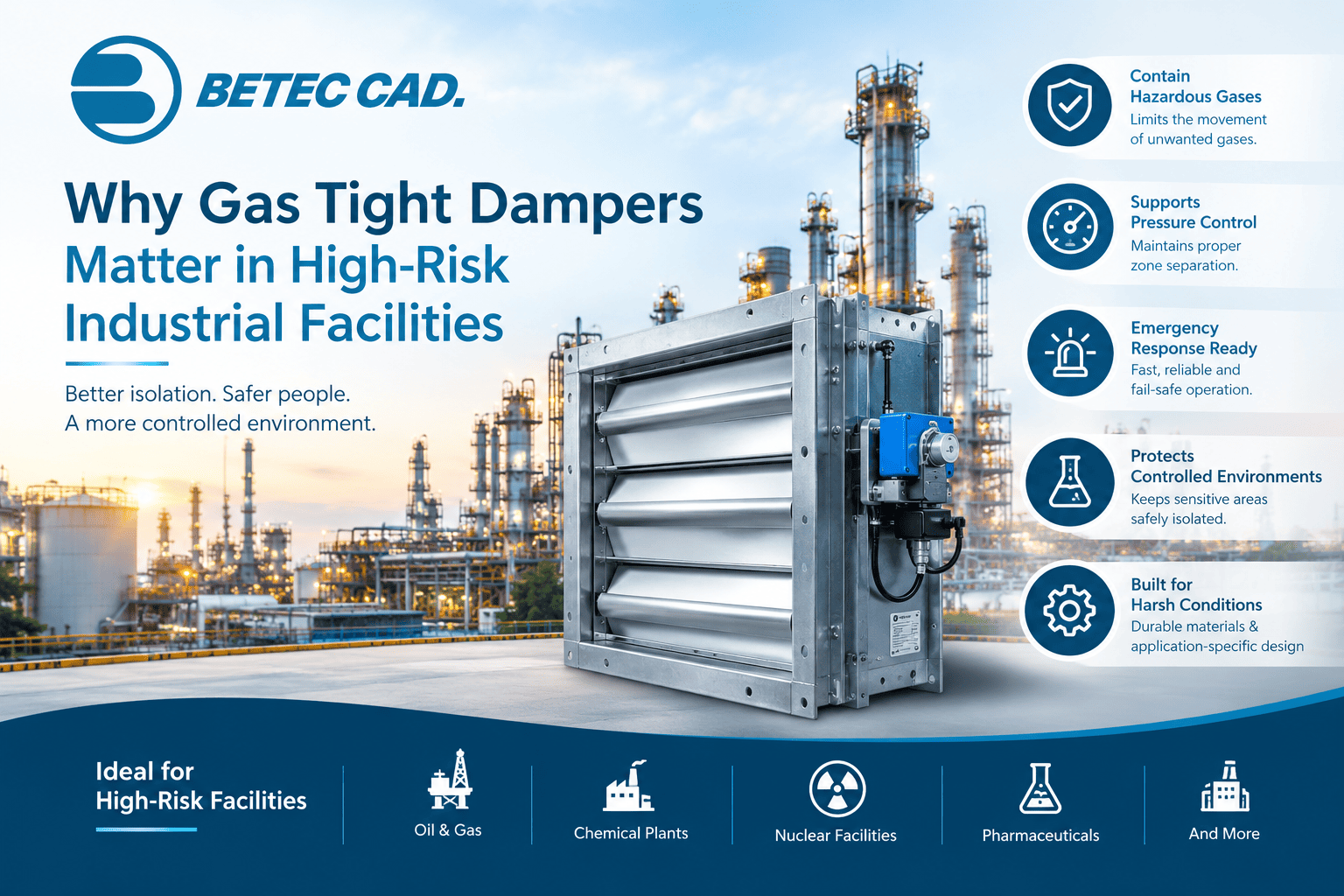
High-risk facilities need proper ventilation and that means more than just moving air from one place to another. A proper ventilation system also stops hazardous gases from spreading through ducts. It isolates contaminated areas and protects the people inside the building when conditions change. Gas-tight dampers are a critical part of this system, and they matter enormously in any high-risk facility.
From oil and gas facilities to nuclear plants, chemical units, and other controlled environments, even a small amount of unwanted leakage can create a serious safety concern. Choosing the right damper is therefore not just an equipment decision it’s part of building a safer, more controlled facility.
What Makes a Gas Tight Damper Different
A conventional damper mainly controls airflow. A gas tight damper has a more demanding job: it must also create a strong seal when the airflow needs to be isolated.
Controlling unwanted gas movement
When a hazardous gas is detected, ventilation sections may need to be isolated quickly. Properly designed gas tight dampers help close off the duct path and reduce the possibility of gas moving between different areas of a facility. This is especially important in oil and gas environments, where ventilation systems can form part of the overall safety strategy.
Supporting pressure control
Industrial facilities often depend on controlled pressure differences between rooms or zones. If air or gas leaks through a closed damper, maintaining that separation becomes more difficult. A well-selected damper helps the HVAC system maintain the intended airflow direction and isolation.
Why Are They Important in High-Risk Facilities
The value of these dampers becomes clearer when you look beyond normal HVAC operation.
They help contain hazardous gases
A gas leak does not always remain where it starts. Ductwork can become an unintended route through which gases travel. Gas-tight isolation helps reduce this risk by limiting the movement of air and gas when a section of the system needs to be closed.
They support emergency response
During an emergency, equipment needs to respond predictably. Industrial specifications can require motorised dampers to close within defined response times and to move to a safe position if power or control conditions are lost. This makes actuator selection, fail-safe operation and proper testing just as important as the damper itself.
They protect controlled environments
Gas-tight isolation is also useful where a room must remain separated from the surrounding HVAC network. High-containment laboratories, for example, can use gas-tight dampers to isolate rooms during decontamination or other controlled processes.
They need to suit the actual environment
Not every industrial damper is suitable for every facility. Temperature, pressure, corrosive conditions, operating frequency, actuator type and required leakage performance all influence the selection. Betec Cad, for example, lists gas-tight damper solutions with stainless-steel aerofoil blades and a stated operating temperature range of -40°C to 50°C.
What Should You Look For When Selecting a Gas Tight Damper?
A good selection starts with the application rather than simply choosing the most expensive product.
- Leakage performance: Check how much leakage is permitted when the damper is closed and what test standard applies.
- Material: The construction should suit moisture, chemicals, temperature and other site conditions.
- Actuation: Electric or pneumatic operation should match the facility’s control and safety requirements.
- Fail-safe operation: The damper should move to the required safe position during a power, signal or air-supply failure.
- Testing and maintenance: Position indicators, access for maintenance and periodic testing should be considered from the beginning.
For critical projects, working with the best HVAC manufacturing company in UAE can also make a difference because damper selection needs to work with the complete HVAC and safety system, not as an isolated component.
FAQs
1. Are gas tight dampers only used in oil and gas facilities?
A. No. They can also be used in nuclear facilities, chemical and pharmaceutical plants, laboratories, marine applications and other environments where controlled isolation is important.
2. Can gas dampers be automated?
A. Yes. Depending on the application, they can be manually, electrically or pneumatically operated. Automated versions can also be connected to the facility’s safety or control system.
3. Is a gas-tight damper the same as a normal HVAC damper?
A. No. A normal damper may regulate airflow, while a gas-tight model is designed with much greater emphasis on sealing and isolation.
Conclusion
In high-risk industrial facilities, ventilation is closely connected to safety. The right gas tight dampers can help control gas movement, isolate sections of ductwork and support reliable emergency response. Their effectiveness, however, depends on correct sizing, sealing, actuation, testing and application-specific selection.
If you want the best quality gas tight dampers, Betec Cad is considered as one of the best HVAC manufacturing companies in the UAE.
Follow us on Instagram.