
What Are Duct Heaters and Why Are They Important in HVAC Systems?

A comfortable indoor environment is not solely about cooling, it is about maintaining thermal comfort year-round. In commercial and industrial buildings, maintaining the correct supply air temperature throughout all seasons requires the integration of heating and ventilation systems. Duct heaters are a critical component of these systems, typically installed within the air handling unit (AHU) ductwork where they are not directly visible. They play a fundamental role in delivering conditioned, thermally comfortable air to occupied spaces.
Whether in an office, hospital, manufacturing facility or shopping mall, the correct heating solution is essential. It directly impacts occupant comfort, protects downstream HVAC equipment from thermal stress and contributes to overall system energy efficiency. Duct heaters are an integral part of modern heating, ventilation, and air conditioning (HVAC) systems. Let us examine why they are so important.
What Are Duct Heaters?
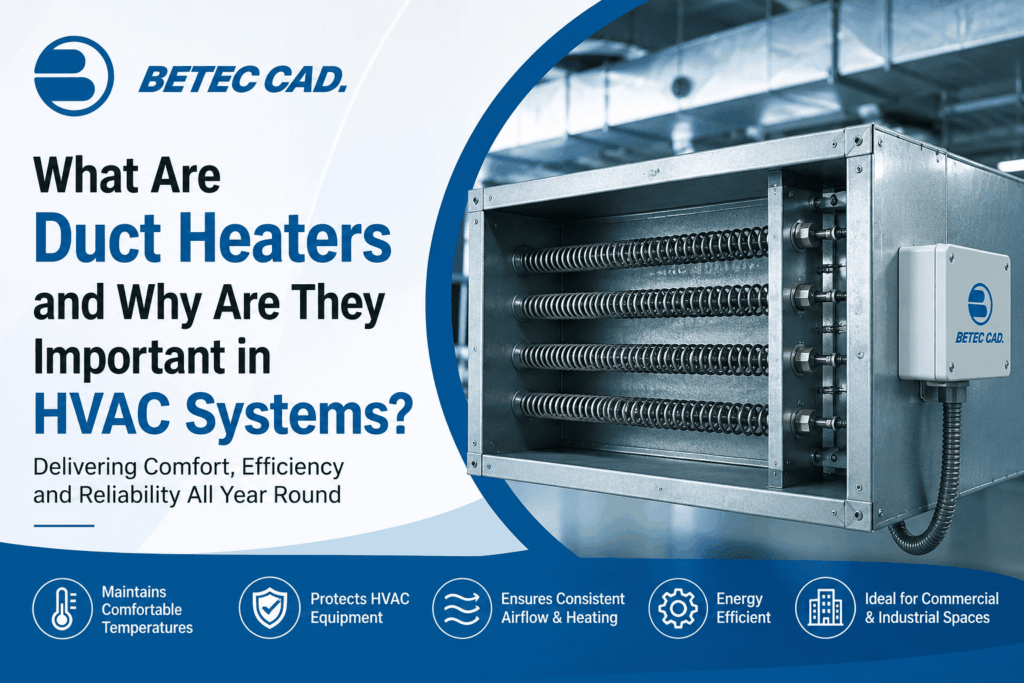
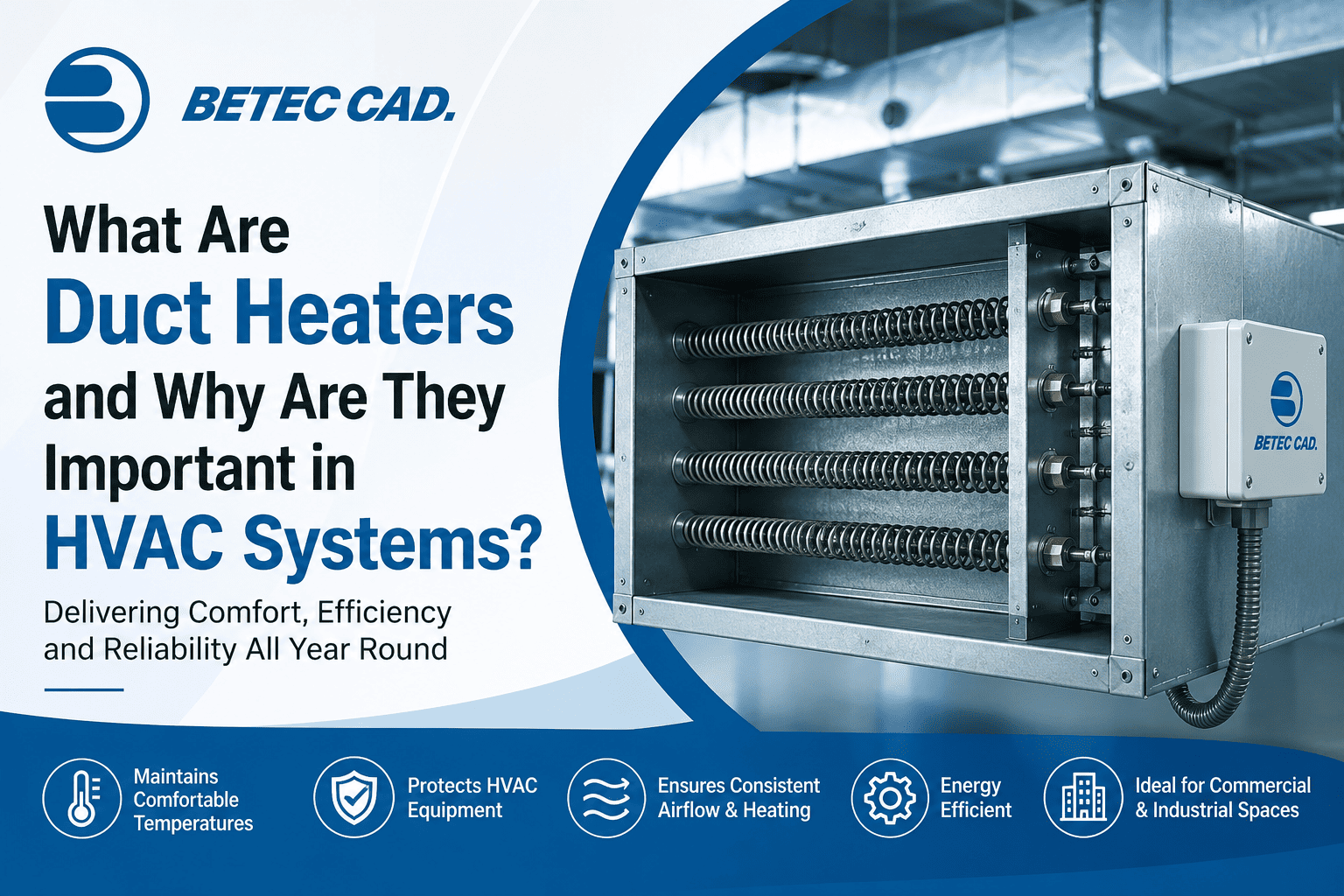
A duct heater is an electric air heating device designed for installation within HVAC ductwork. Its primary function is to raise the temperature of the supply air before it is distributed to the various zones of a building. Duct heaters are commonly used in commercial buildings such as offices, schools, and healthcare facilities, where maintaining consistent supply air temperatures is critical for occupant comfort and process requirements.
These heaters utilize electric resistance heating elements to generate thermal energy. The two predominant element configurations are:
Open Coil Elements:
Constructed from high-grade 80% nickel / 20% chromium (Nichrome) resistance wire, supported by high-temperature ceramic insulators. Open coil designs offer very low air pressure drop, rapid thermal response, and high heat transfer efficiency because the heating wire is in direct contact with the airstream. They are the most economical choice for standard comfort heating applications.
Finned Tubular Elements:
Consist of a resistance coil centered within a magnesium oxide (MgO) filled stainless steel sheath, with external stainless steel fins to increase the heat transfer surface area. Finned tubular elements operate at lower watt densities, making them suitable for harsher environments, higher kW outputs, and applications involving dust or moisture. They also offer superior mechanical protection and are easier to replace in the field.
Duct heaters are available in slip-in (insert) or flanged configurations to suit different installation requirements. They are engineered to work in conjunction with air handling units, fans, and building automation systems (BAS) without creating significant airflow restriction.
What Are Duct Heaters Important in HVAC Systems?
1. They Maintain Comfortable Indoor Temperatures
During cold weather, or in buildings with strict temperature control requirements, the supply air from the AHU can be too cold for occupant comfort. Duct heaters raise the air temperature to the desired setpoint before it reaches the occupied zones, ensuring that employees, customers, patients, and visitors remain comfortable.
2. They Prevent Cold Drafts from Outdoor Air Intake
Even when cooling is not required, ventilation systems continue to introduce fresh outdoor air to maintain indoor air quality (IAQ). Without adequate preheating, this incoming air can create uncomfortable cold drafts. Duct heaters, particularly those installed on the outdoor air intake, eliminate these drafts and maintain stable indoor conditions.
3. They Protect Downstream HVAC Equipment
In certain HVAC configurations, excessively cold supply air can cause operational problems. Preheating the air helps prevent:
- Condensation and frost formation on cooling coils and duct surfaces.
- Ice buildup that can restrict airflow and damage components.
- Excessive thermal cycling stress on heat exchangers, compressors, and other mechanical parts.
- By maintaining the air temperature within design parameters, duct heaters improve overall system reliability and extend equipment service life.
Benefits of Duct Heaters
- Quick and uniform zonal heating across different building zones.
- Consistent indoor temperatures maintained throughout the operating day.
- Elimination of cold spots, improving overall occupant comfort.
- Seamless integration with modern Building Management Systems (BMS) and Direct Digital Control (DDC) systems.
- Energy-efficient operation when properly sized and controlled via staged or modulating (SCR) control.
- Wide range of capacities to suit commercial and industrial applications.
- Relatively simple maintenance when installed with proper access provisions.
Where Are Duct Heaters Commonly Used?
Commercial Buildings
Office buildings, shopping malls, and hotels require spaces to be maintained at comfortable temperatures. Duct heaters are used to temper supply air without compromising ventilation rates or indoor air quality. They ensure that occupants remain comfortable while the building meets its required air changes per hour (ACH).
Hospitals and Healthcare Facilities
Healthcare environments demand precise temperature and humidity control. Heated supply air supports patient thermal comfort while maintaining the controlled indoor conditions necessary for infection control and medical equipment operation.
Manufacturing Facilities
Factories often require stable indoor temperatures to protect both personnel and temperature-sensitive production equipment. Properly designed heating systems improve workplace conditions and process consistency throughout the year.
Educational Institutions
Schools and universities use duct heaters to maintain comfortable conditions in classrooms, lecture halls, and libraries, particularly during cooler weather or in areas with high outdoor air requirements.
Choosing The Right Duct Heaters
Not every heating system is suitable for every building. The correct selection depends on several engineering parameters:
Heater capacity (kW) based on the required temperature rise and airflow rate (CFM or m³/s).
Duct dimensions to ensure proper face velocity and avoid excessive pressure drop.
Electrical supply—voltage, phase (single or three-phase), and frequency.
Control strategy—on/off staging, step controllers, or proportional SCR (thyristor) control for precise modulation.
Safety requirements—primary (automatic reset) and secondary (manual reset) thermal cutouts, airflow switches, and magnetic contactors per NEC and UL standards.
Environmental conditions—whether the application requires open coil or finned tubular construction.
Many businesses searching for reliable HVAC manufacturing companies in the UAE look for manufacturers that offer custom-engineered HVAC products rather than standard off-the-shelf solutions. Experienced HVAC manufacturing companies in the UAE also ensure that duct heaters meet international safety standards (such as UL and NFPA), deliver reliable performance under design conditions and integrate smoothly with building automation systems.
Working with an experienced HVAC manufacturer helps improve system efficiency while reducing long-term maintenance and operating costs.
FAQs
1. What is the purpose of a duct heater?
A. A duct heater raises the temperature of air inside HVAC ducts before it is distributed throughout a building, helping maintain comfortable and stable indoor temperatures.
2. Are duct heaters energy efficient?
A. Yes. When properly sized, staged, and controlled ideally with SCR proportional controllers. Duct heaters operate efficiently by heating only the required airflow, minimizing energy waste.
3. Do duct heaters work with building automation systems?
A. Yes. Modern duct heaters can be interfaced with Building Management Systems (BMS) for automatic temperature control, remote monitoring, and energy optimization.
4. Can duct heaters improve indoor air quality?
A. While their primary function is thermal conditioning, duct heaters support indoor air quality by maintaining comfortable air temperatures without restricting the ventilation airflow required for proper IAQ.
Conclusion
Although they remain concealed within HVAC ductwork, duct heaters play a vital role in keeping buildings comfortable, efficient and reliable. From maintaining consistent supply air temperatures to supporting ventilation requirements and protecting downstream HVAC equipment, they contribute significantly to overall system performance.
If you are looking for dependable HVAC solutions from trusted HVAC manufacturing companies in the UAE, Betec Cad offers high-quality duct heaters and engineered HVAC products designed for long-lasting performance. With over two decades of experience in designing and manufacturing durable, high-performance HVAC components including UL-classified fire dampers, smoke dampers, volume control dampers and custom-engineered duct heaters, Betec Cad has established itself as a leader in the region’s HVAC and fire safety industry. Their products are constructed from heavy-duty galvanized or stainless steel, meet stringent international standards, and are custom-built to meet the exact needs of virtually any ventilation application. Betec Cad’s commitment to continuous research and development, combined with their extensive global network, ensures fast delivery, reliable support and products that stand up to the toughest and most demanding environments.
Follow us on Instagram.